

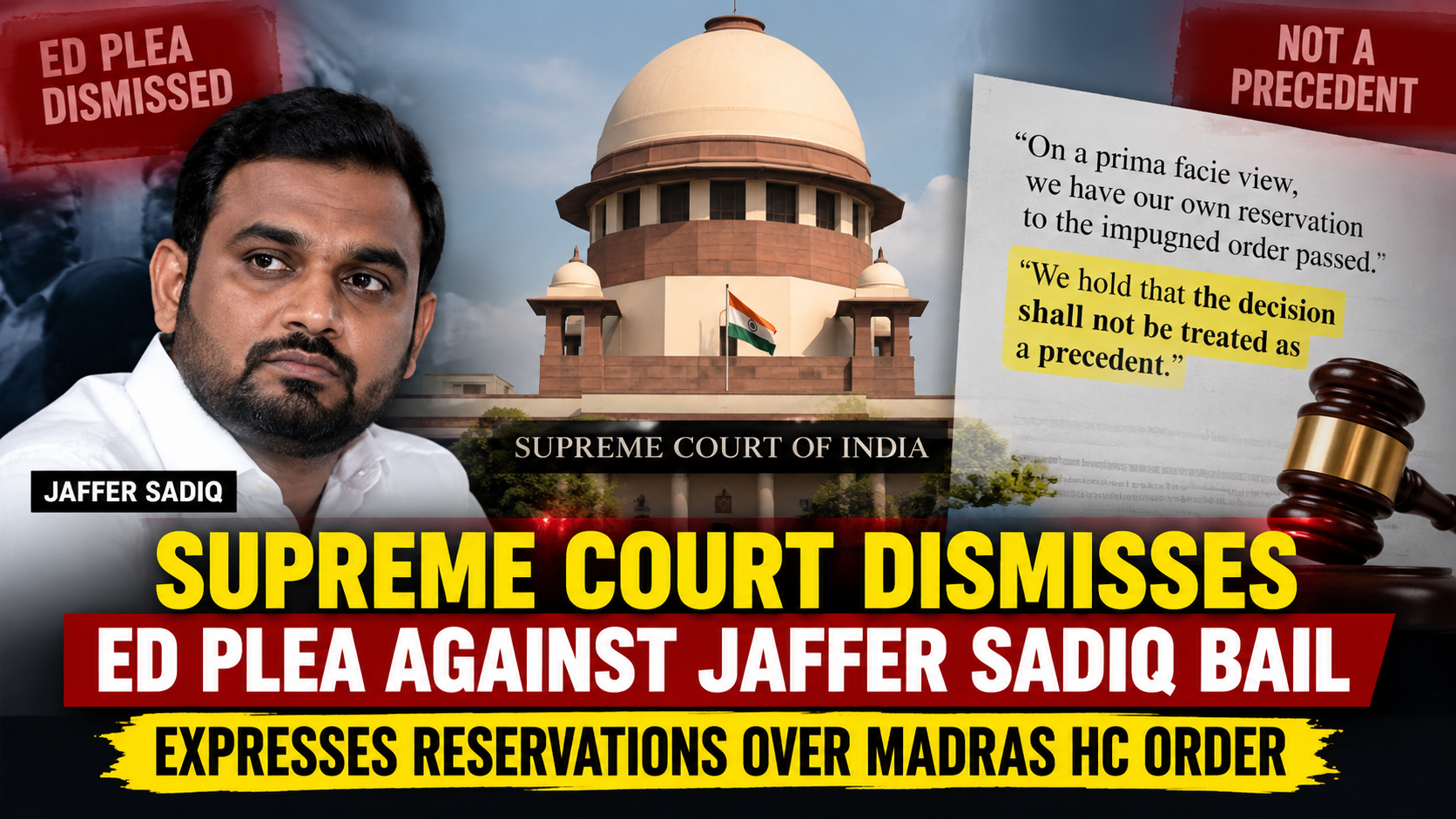
Apex court declines to interfere with April 2025 order citing passage of time; says the decision cannot be treated as a precedent
The Supreme Court has dismissed the challenge filed by the Assistant Director against the Madras High Court order concerning the bail granted to Jaffer Sadiq, but the outcome comes with a significant qualification.
A Bench comprising Justice M.M. Sundresh and Justice Augustine George Masih, which heard the matter on September 2, 2026, observed that it had “own reservation” about the impugned order on a prima facie view. Despite this, the Bench decided not to interfere with the Madras High Court’s order, noting that it had been passed more than a year ago.
The Supreme Court also made it expressly clear that its decision shall not be treated as a precedent.
The proceedings arose from two Special Leave Petitions — SLP (Crl.) Nos. 18736 and 18737 of 2025 — filed by the Assistant Director against the April 21, 2025 orders passed by the Madras High Court in Criminal Original Petition Nos. 3508 and 3510 of 2025.
The matter was heard by the apex court after the petitioner challenged the earlier High Court proceedings involving Jaffer Sadiq and the other respondent.
Supreme Court’s observation raises the key question
The most significant aspect of the September 2 order is not merely the dismissal of the petitions, but the language used by the Supreme Court while doing so.
After hearing Additional Solicitor General Anil Kaushik for the petitioner and senior counsel representing the respondents, the Bench recorded, “On a prima facie view, we have our own reservation to the impugned order passed.”
The Court, however, immediately explained why it was not prepared to reopen the matter.
The High Court order had been passed more than a year earlier and, taking that delay into consideration, the Supreme Court said it was “not inclined to interfere with the same.”
The Bench then added a separate and important direction, “We hold that the decision shall not be treated as a precedent.”
Thus, while the earlier order remains undisturbed, the Supreme Court has made it clear that its decision should not be relied upon as establishing a precedent for other cases.
What exactly has the Supreme Court decided?
The order creates an important distinction between the continuation of the existing order and approval of the reasoning behind it.
The Supreme Court has not set aside the Madras High Court order. At the same time, it has not endorsed the High Court’s reasoning either.
In fact, the apex court has expressly recorded reservations about the order on a prima facie assessment.
The reason for allowing the order to remain undisturbed was the passage of more than a year since it was issued.
Consequently, the September 2 order cannot accurately be described as a Supreme Court ruling affirming the reasoning of the Madras High Court. Nor does the dismissal of the petitions amount to a finding on the merits of the underlying allegations against the respondents.
The Supreme Court’s operative decision was limited: it declined to interfere with the existing order and simultaneously directed that the decision would have no precedential value.
The Supreme Court proceedings originated from two orders passed by the Madras High Court on April 21, 2025.
The Assistant Director subsequently approached the Supreme Court through the two Special Leave Petitions challenging those orders.
The case remained pending before the apex court during 2026. Earlier proceedings show that the Court had granted time for the filing of pleadings and additional documents before the matter was finally taken up for hearing.
On May 27, 2026, the Supreme Court had directed that the matters be listed later, while permitting the respondents to place additional documents on record.
The matter ultimately came up before the Bench of Justice M.M. Sundresh and Justice Augustine George Masih on September 2
After hearing both sides, the Supreme Court dismissed the two Special Leave Petitions.
The Court also ordered that any pending applications would stand disposed of.
The immediate consequence is that the Madras High Court’s April 2025 order remains undisturbed.
However, the Supreme Court’s explicit direction regarding precedent gives the order a considerably narrower legal significance.
The September 2 development can therefore be understood as a qualified dismissal rather than an endorsement of the earlier High Court ruling.
The Assistant Director has not succeeded in getting the Madras High Court order overturned. But the Supreme Court has also made clear that it has reservations about that order and does not want its present decision to become a precedent.
For Jaffer Sadiq, the immediate position is that the challenged High Court order remains intact.
For future cases, however, the Supreme Court has specifically cautioned against treating this decision as a precedent.
The distinction is important: the Supreme Court has declined to interfere with the existing order because of the time that has elapsed, while expressly reserving its position on the correctness of that order and denying the decision precedential value.